For twenty years the deal was simple. Someone typed a question, Google showed ten links, and if you were one of them you got a visitor. AI search breaks the deal in one specific place: the answer now appears on the results page, written out, and a great many people never click anything at all.
That is a real change and it is worth understanding properly, because most of the advice being written about it is either panic or a rebrand of things that were already true. Very little about AI search means the last decade of work was wasted. A few things about it genuinely are new.
What actually changed
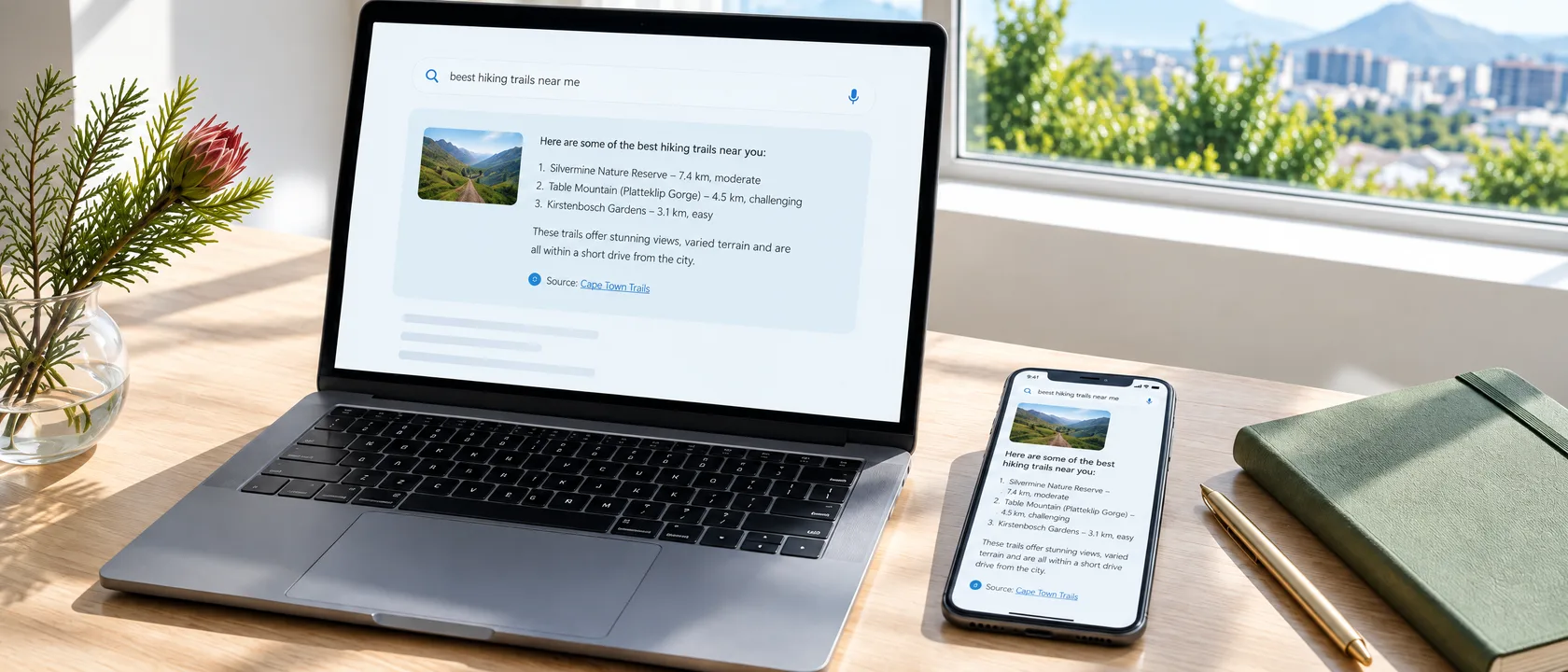
One thing, and everything else follows from it. The search engine has stopped being an index that points at answers and started being a thing that gives answers. Google writes a summary at the top of the page. ChatGPT and Perplexity skip the results page altogether and just reply.
Three consequences fall out of that, and they matter in different ways.
- Fewer clicks for the same number of searches. The question gets answered without you.
- Better clicks, though. Someone who reads a summary and still clicks through has a reason. They are further along and closer to buying.
- A new way to be visible without a click at all: being the source the answer was assembled from, and often named as such.
Your page is no longer competing for a position on a list. It is competing to be the sentence the machine repeats.
What did not change, which is most of it
The uncomfortable truth for anyone selling a new discipline is that AI search runs on the same substrate as ordinary search. An answer engine cannot quote a page it cannot crawl, cannot parse, or does not trust. So the boring work is still the work.
- The page has to be crawlable and fast. Nothing quotes a page it timed out on.
- It has to actually answer the question it claims to answer, in the words a person would use.
- Structure still carries meaning. Headings, lists and tables are how a machine works out which part of your page is the answer.
- Expertise still shows. Thin pages assembled from other people summaries were always weak, and they are now weak in a way that is measurable, because nothing quotes them.
If a business has not done that work, AI search is not its problem yet. Being invisible is.
The part that is genuinely new: writing to be extracted
Here is the shift worth internalising. A page written for a human reader can afford to build. It can open with a scene, add context, and arrive at its point in the fourth paragraph, because a person will follow. A page being read for extraction cannot. The machine is looking for a passage that answers the question on its own, and it will take the clearest one it finds, from you or from somebody else.
So the practical change is to put the conclusion where it can be lifted. State the answer plainly, early, in a complete sentence that survives being read with nothing around it. Then build the argument underneath for the human who stayed. This is not dumbing anything down. It is the inverted pyramid that journalism worked out a century ago, applied to a new reader.
| Written to be read | Written to be extracted |
|---|---|
| It depends on your situation, but generally speaking... | A retainer suits continuous work. A project suits work with a defined end. |
| We have found over the years that many clients... | Most small businesses in South Africa spend between R5,000 and R15,000 a month. |
| There are several factors to consider here | Three things decide it: budget, timeline and who owns the account. |
| As mentioned above, this is the key point | The key point, stated again in full so it stands alone. |
The right-hand column is what gets quoted. Notice that none of it contains a pronoun pointing at something earlier on the page, and none of it needs the sentence before it. That is the entire test.
The four things worth doing
- 01Answer in the first hundred words. Whatever the page is about, say the conclusion near the top in one clean sentence, then explain it. Everything downstream depends on this one.
- 02Use question-shaped headings. People ask search engines questions in full. A heading that matches the question is easier to match against than a clever one.
- 03Put a real FAQ on the page, and mark it up. Four to six genuine questions, each answered in two or three sentences that stand on their own. The structured data must match what a visitor can see, or it works against you.
- 04Say who you are and how you know. Answer engines lean on provenance. A named author, a real business address, a date and a source for any figure are what separate a citable page from a plausible one.
How to tell whether it is working
This is where most people get the wrong answer, because the obvious metric moved. Clicks can fall while the page does more work than it ever has, and if clicks are all you watch you will conclude something is broken and change the thing that was working.
- Impressions, not just clicks. Rising impressions with flat clicks usually means you are appearing inside answers.
- Branded search volume. People who read about you in a summary often search your name afterwards. That is the signal that survives the missing click.
- What happens after arrival. Fewer, better-qualified visitors should convert at a higher rate. If they do, the traffic drop is a change in mix and not a loss.
- Direct citations. Ask the assistants your customers use the questions your customers ask, and see whether you are named. It is not a dashboard, but it is the ground truth.
The honest summary
AI search is a real shift and a smaller one than it is being sold as. The businesses that will do well in it are the ones that would have done well before: they know something, they say it clearly, and their site is quick and legible. The change is that saying it clearly now has a second beneficiary, and that vagueness has stopped being merely unpersuasive and started being invisible.
Sources and method
- Search behaviour claims restricted to observable mechanics of AI answer surfaces as at August 2026. No CTR percentage is quoted, deliberately: the published figures vary by an order of magnitude between studies and by query type, and a precise-sounding number would be the least defensible thing on the page.
- Crawler behaviour taken from the operators own published documentation for GPTBot, ClaudeBot, PerplexityBot and Google-Extended.
Written by Assay House, a South African brand strategy and creative agency. Published 28 August 2026.